 Deutsch
 English
Top 40
Artificial intelligence is changing many professions – new Microsoft study shows which are most affected
Artificial intelligence (AI for short) is no longer just a trend. It is already changing how people work today. Many use AI programs such as ChatGPT or Microsoft Copilot to write texts, find information or complete tasks more quickly. But AI can do much more – and that is exactly what worries some people.
A new study by Microsoft researchers now shows: There are professions in which AI could take over particularly many tasks. The study identified specific jobs that could be heavily affected and the most frequent work activities for which people make use of AI support.
This is how the study was conducted
For the study, the researchers analyzed real data from the use of Microsoft Copilot. More than 200,000 conversations were evaluated – of course anonymously, without users’ personal data.
They wanted to see:
In which professions are AI functions used particularly often? Where can AI help the most or even almost completely take over tasks?
From this they created a list. It shows how strongly individual professions could be influenced by AI. At the top are professions that involve a lot of work with language, text, information or data.
Microsoft writes:
We find the highest AI applicability scores for knowledge-based occupations such as computer and mathematics occupations as well as office and administrative employees and for occupations such as sales, whose work activities include providing and communicating information. In addition, we characterize the types of work activities that are performed most successfully, how wages and education correlate with the applicability of AI, and how real-world usage compares with predictions about the impact of AI on occupations.
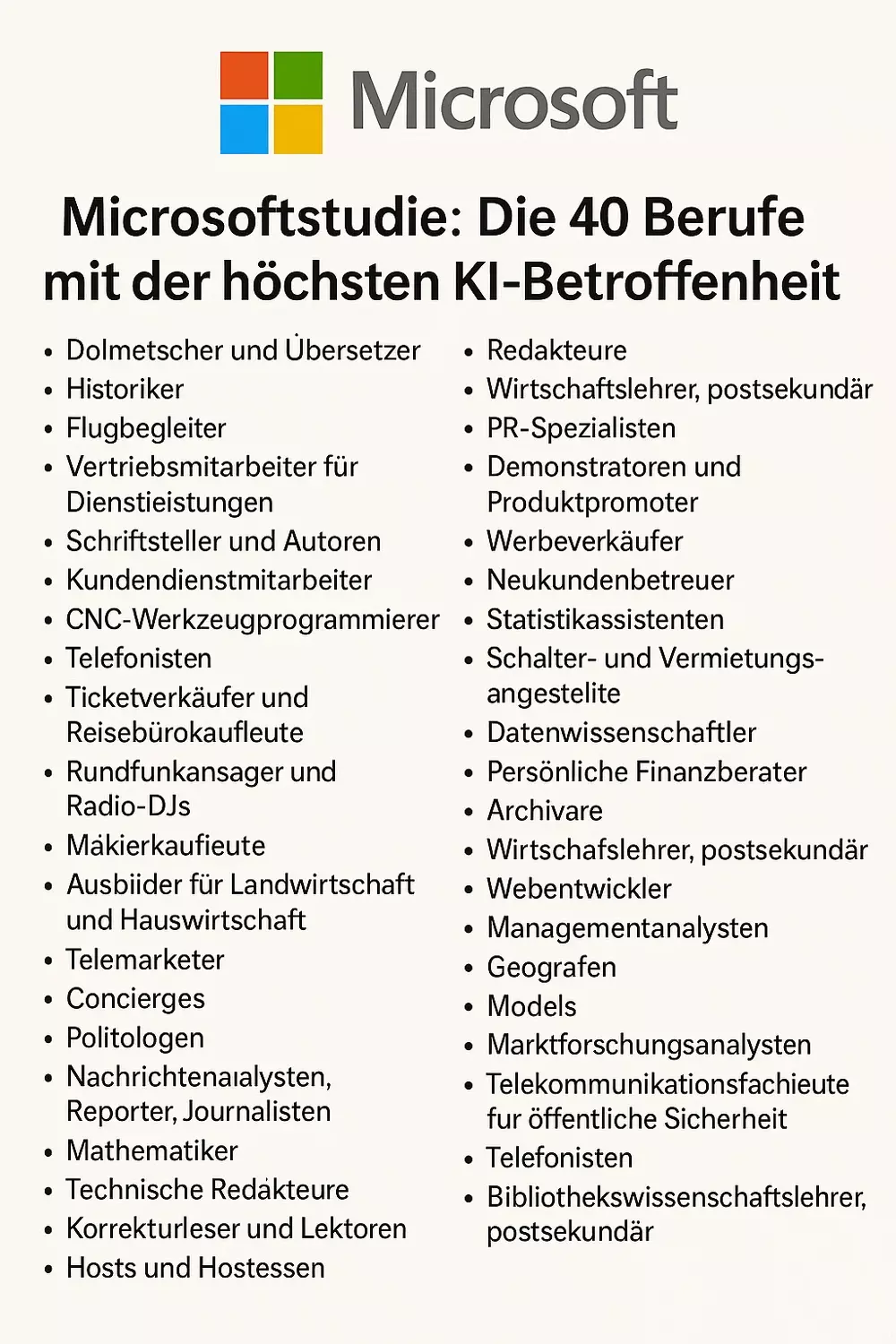
This makes it easy to determine the 40 professions most affected by AI
The following professions are considered particularly susceptible to change due to AI:
-
Interpreters and translators
-
Historians
-
Flight attendants
-
Sales representatives for services
-
Writers and authors
-
Customer service representatives
-
CNC tool programmers
-
Telephone operators
-
Ticket agents and travel agents
-
Radio and television announcers and radio DJs
-
Brokers
-
Instructors in agriculture and home economics
-
Telemarketers
-
Concierges
-
Political scientists
-
News analysts
-
Reporters, journalists
-
Mathematicians
-
Technical writers
-
Proofreaders and editors
-
Hosts and hostesses
-
Editors
-
Economics teachers, postsecondary
-
PR specialists
-
Demonstrators and product promoters
-
Advertising sales agents
-
New account representatives
-
Statistical assistants
-
Counter and rental clerks
-
Data scientists
-
Personal financial advisors
-
Archivists
-
Graphic designers
-
Web developers
-
Management analysts
-
Geographers
-
Models
-
Market research analysts
-
Telecommunications specialists for public safety
-
Library science teachers, postsecondary
Why these professions in particular?
These professions often have one thing in common:
They involve a lot of work with language, texts, data or information processing. AI is already very strong in exactly these areas.
An example:
-
Translators: AI can translate texts into many languages in seconds.
-
Customer service: Chatbots can answer simple inquiries around the clock.
-
Journalists: AI can quickly summarize reports or research facts.
This does not mean that people will become superfluous. But their work is changing. Instead of doing simple routine tasks, they can focus on more difficult or creative tasks.
Opportunities and risks
Many see AI primarily as an opportunity. It can save time, reduce errors and provide ideas.
Example: An editor can use AI to create a first draft of a text and then focus on fine-tuning it. A market researcher can have large amounts of data evaluated automatically in order to identify trends more quickly.
Others see more risks:
-
Fewer jobs in certain areas
-
The danger that people become too dependent on AI
-
Quality suffers if AI errors go unnoticed
The truth is probably somewhere in between. How strong the actual impact will be depends on how companies and employees use AI.
What can those affected do?
Experts recommend:
-
Further training is crucial. Those who learn to work with AI tools remain competitive.
-
Creativity and social skills are hard to automate.
-
New fields of work are emerging in dealing with AI: AI must be checked, improved and monitored.
Microsoft also emphasizes: The study is not intended to cause fear. It is meant to show where AI can already bring about major change today – and where employees should prepare for it.
Not all professions are equally affected
There are also professions that are hardly affected by AI at all – such as skilled trades, caregivers or construction workers. Wherever physical work, direct contact and practical experience are important, AI can still hardly keep up today.
This insight is not new: even with earlier technological developments, such as the introduction of computers or machines, it was primarily office and information professions that were changed first.
The Microsoft study makes it clear:
Artificial intelligence will change many professions – and faster than many think.
Professions that involve a lot of language and information work will be particularly affected. This is a challenge, but also a major opportunity.
Those who engage with the new possibilities early on can use AI as a tool – instead of being replaced by it.
In the end, one thing applies: the technology is here. Now it depends on how we humans deal with it.
Here are the top 40 professions that are rather unaffected
- Phlebotomists
- Nursing assistants
- Hazardous materials removal workers
- Helpers – painters, plasterers, ...
- Embalmers
- Plant and system operators, all other
- Oral and maxillofacial surgeons
- Automotive glass installers and repairers
- Ship engineers
- Tire repairers and changers
- Prosthetists
- Helpers – production workers
- Highway maintenance workers
- Medical equipment preparers
- Packaging and filling machine operators
- Machine feeders and offbearers
- Dishwashers
- Cement masons and concrete finishers
- First-line supervisors of firefighting workers
- Industrial truck and tractor operators
- Opticians
- Massage therapists
- Surgical assistants
- Tire builders
- Helpers – roofers
- Gas compressor and gas pumping station operators
- Roofers
- Helpers, oil and gas
- Maids and housekeeping cleaners
- Paving, surfacing and tamping equipment operators
- Logging equipment operators
- Motorboat operators
- Caregivers
- Floor sanders and finishers
- Pile-driver operators
- Rail-track laying and maintenance equipment operators
- Molding and coremaking workers, foundry
- Water and wastewater treatment plant and system operators
- Bridge and lock tenders
- Excavator operators